How to write evaluation questions that give you useful answers
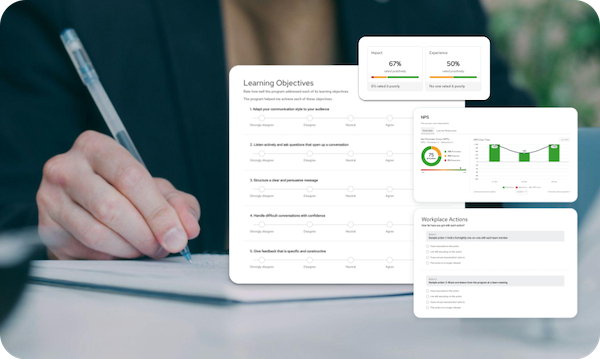
You’re about to run your program again, so you open the last cohort’s evaluation to see what needs to change. The comments read “Great session”, “Really enjoyed it”, and “Thanks!”. Most of the open-ended boxes are blank, and every module scored somewhere around 4 out of 5.
You know some parts of the program landed better than others – your facilitators could feel it in the room. But the survey can’t tell you which parts, or why. That isn’t a data problem. It’s a question problem. When evaluation questions are vague, the answers are vague too, and you’re left redesigning on gut feel despite asking learners for their time.
Good evaluation questions are written to inform a decision. Here’s how to write questions that tell you what to keep, what to fix, and what’s making a difference at work. You’ll also explore why a shared question library makes every evaluation you run more valuable than the last.
Start with the decision, not the question
Before you write a single question, ask what you'll do with the answer. Will it help you improve a session? Show a sponsor that learning reached the workplace? Decide whether to run the program again? If you can't name the decision a question informs, it probably doesn't belong in your survey.
This one filter shortens most surveys considerably – and shorter surveys get more, and more thoughtful, responses.
Know what each question is measuring
Evaluation questions tend to fall into a few distinct groups:
- Recommendation – would learners recommend the program to a colleague?
- Experience – how did the program feel: content, pace, facilitation, venue, and technology?
- Impact – what has changed for the learner: confidence, capability, and application at work?
- Learning objectives – did the program deliver what it promised?
- Sessions and facilitators – how did each part of the delivery land?
Keeping these groups separate matters. If experience and impact questions are mixed together, a high score can hide the fact that learners enjoyed the program but aren't using it. Separate groups give you separate, clearer stories – and they're far easier to report on.
Eight principles for questions that work
1. Ask one thing at a time. "The content was relevant and well paced" is two questions. If a learner disagrees, you won't know which part they disagree with.
2. Make it about the learner's work, not your course. "The content was relevant" tells you about the course. "I can apply what I learnt directly in my current role" tells you about impact. The second is far more useful to you and your sponsor.
3. Define your scale. What separates a 3 from a 4? Without descriptions, each learner decides for themselves. Labelling each point – from "strongly disagree" to "strongly agree", or describing what "very good" looks like – makes responses consistent and comparable.
4. Use the same scales everywhere. When scales differ from program to program, a score of 4 means something different each time. Pick a small set of standard scales and stick with them.
5. Follow a rating with a reason. A score tells you what; a short follow-up tells you why. "This program has made me more confident in my role" becomes far more useful when followed by "What has given you the most confidence?"
6. Use open questions sparingly and precisely. "Any other comments?" invites silence or a single word. "What will you apply first?" invites a specific, usable answer.
7. Match the question to the moment. At the end of a program, learners can only tell you what they intend to do. In a follow-up survey months later, rewrite impact questions in the past tense – "I have applied what I learnt in my role" – to capture what happened.
8. Make every question earn its place. Don't ask learners to rate a session they've already rated, or answer questions that won't change anything. Unnecessary questions invite careless answers.
Here's how a few common questions can be sharpened:
| Weak question | Better question |
|---|---|
| Did you enjoy the program? | How likely are you to recommend this program to a colleague? |
| Was the content relevant and engaging? | I can apply what I learnt directly in my current role. |
| Any other comments? | What will you apply first? |
| Was the program useful? | This program has made me more confident in my role. |
| Did you use what you learnt? (follow-up) | Since the program, I have used what I learnt to improve how I work. |
Building a question library you can reuse across every program
Once you’ve written good questions, the next step is to reuse them across every program.
In many organisations, each program designer writes their own evaluation. One asks learners to rate their "confidence", another their "self-belief". One uses a five-point scale, another uses seven. Each survey makes sense on its own, but they can't be compared when placed side by side. You end up with dozens of evaluations and no way to answer simple portfolio questions: Which programs build the most confidence? Is impact improving year on year? How does this cohort compare with the last?
A shared question library solves this.
Why consistent questions make results comparable over time
When the same question is asked the same way across every program, each answer adds to a growing body of evidence. That consistency unlocks value a one-off survey never can, and enables you to:
- Measure trends over time – track how a result, such as confidence or application, moves from cohort to cohort, and year to year
- Compare across programs – see which programs drive the strongest impact, and which need attention
- Create portfolio reports – roll results up by program category, business unit, or client to show the value of your whole offering
- Set credible benchmarks – tell a sponsor how their cohort performed against your typical results
- Save time on setup – build a new evaluation in minutes from proven questions, rather than starting from a blank page
For training providers, this is a commercial advantage too. Being able to say "our leadership programs consistently lift confidence across every client" is far more persuasive than a single set of results.
How to build your library
Start small. A core set of well-written questions for each category – recommendation, impact, experience, and workplace application – will cover most programs. Pair them with a small set of standard, clearly labelled rating scales.
Then, protect the library's consistency:
- Make shared questions the default. Program-specific questions still have a place, but they won't roll up into portfolio reporting, so use them sparingly.
- Edit wording with care. Fixing a typo is fine; changing what a question means breaks comparison with past results.
- Archive rather than delete. Retired questions should keep their history, so past reports stay intact.
- Group questions into themes. Tagging questions by theme, such as capability or confidence, lets you report at a higher level without reviewing every individual question.
Frequently asked questions
How many questions should an end-of-program evaluation have?
As few as you need to inform your decisions. For most programs, a recommendation question, a handful of impact and experience questions, and one or two open questions are enough.
Should I ever write custom questions?
Yes, when a program has a specific goal the library doesn't cover. Just remember that custom questions sit outside your portfolio comparison, so lead with shared questions and add custom ones on top.
What about open-ended responses at scale?
Open responses are rich but time-consuming to read across large cohorts. Grouping them into themes – increasingly with the help of AI – lets you keep the depth without the manual effort.
How Guroo Academy helps
Guroo Academy's new evaluations are built around a shared question pool. Questions are organised into categories – impact, experience, facilitator, session, recommendation, pulse check, workplace actions, and learning objectives – so results roll up the way you'd expect. The pool comes pre-populated with suggested questions you can review and adapt before you switch evaluations on.
A Likert scale library keeps your scales consistent, with descriptions for each point and optional follow-up prompts for selected ratings. Learning objective questions are generated automatically from the objectives you've already set. Because shared questions are asked the same way everywhere, Mission Control can show how each one is trending across your whole portfolio – and AI theme analysis helps you make sense of open-ended responses.
See how the question pool works – book a demo.
BOOK A 30-MINUTE PERSONALISED DEMO
Spend less time juggling tools and more time running your business.
See how Guroo Academy connects your courses, clients, payments and operations in one platform.