
Manager-led coaching: create change beyond the course
Deliver training outcomes you can see and measure. Manager-led coaching provides structured support that bridges the gap between learning events and workplace application.

Why your training programs need manager-led coaching

Drive workplace application

Increase performance

Build stronger teams

Improve employee retention
The learning transfer problem
You've created impressive training programs that build genuine capability, but without ongoing support, skills rarely stick in the workplace. This familiar challenge faces L&D teams everywhere: various studies find that training alone typically achieves only 15–20% improvement in job performance².
Without ongoing support after training, learners forget an average of 50% of new information within an hour², much more knowledge is lost throughout the week, initial enthusiasm from training sessions diminishes when employees face workplace realities, and new skills are abandoned when challenges emerge.
Manager-led coaching offers a practical, scalable solution by embedding ongoing support into existing workplace relationships.


The manager-led coaching solution
Manager-led coaching involves a learner's workplace manager taking on a coaching role during training programs to support learning and encourage growth. This approach leverages the manager's unique understanding of both organisational context and individual employee needs.
With manager coaching support, learners focus on growth and removing barriers to application of new skills. Regular feedback loops support sustained behaviour change, while managers provide active support during training, and offer structured approaches to application on the job.
The business case for manager led coaching
Research shows that organisations with high coaching capability are twice as likely to be viewed as strategic partners to the business¹, while public sector managers who underwent executive coaching after leadership training displayed an 88% increase in productivity⁴.
Manager-led coaching delivers measurable impact through:
- Performance gains: Manager support plays a crucial role in linking learning to performance outcomes³.
- Employee engagement: 7 in 10 workers say learning improves their sense of connection to their organisation⁶.
- Retention improvement: Companies with strong learning cultures see 57% retention versus 27% for moderate learning cultures⁵.
- Cost efficiency: Leveraging existing managers instead of external coaching services, scaling programs without proportional cost increases.

How manager-led coaching works
The concept is straightforward – managers support their team members through structured touchpoints before, during, and after training programs.

Setting up for success
Learners nominate their coach: during course onboarding, learners select their manager, mentor, or peer as their coach, creating accountability and support from day one.
Goal Consultation: coach and learner meet to discuss learning objectives and how they align with both career aspirations and organisational needs. This establishes clear expectations and creates a shared understanding of what success looks like.
Workplace Context Setting: managers help learners understand how program content connects to their specific work environment, identifying real situations where new skills will be applied.
Baseline Assessment: both learner and coach complete diagnostic assessments separately, then collaborate on final responses that identify current capability levels and priority development areas. This creates a clear starting point for measuring progress.

Supporting active learning
Supportive Environment: coaches create psychological safety where learners feel comfortable sharing struggles, asking questions, and experimenting with new approaches. This safe space is essential for genuine learning.
Regular Check-ins: structured touchpoints during the program sustain momentum and address challenges as they arise. These conversations keep learning front-of-mind and demonstrate the coach's commitment to the learner's development.
Reflection Conversations: coaches help learners process what they're learning, connect concepts to workplace realities, and think through how they'll apply new skills. These discussions aid understanding and application.
Early Practice Opportunities: where possible, coaches create low-stakes opportunities for participants to try new skills, bridging learning and full workplace application. This might include practice in team meetings, small projects, or simulated scenarios.

Embedding skills in the workplace
Structured Application Planning: coach and learner meet to create a specific action plan for applying new skills in real work situations. This moves from "I learned something useful" to "Here's exactly when and how I'll use it."
Practice Opportunities: coaches help identify on-the-job chances to apply new skills with appropriate support and scaffolding. This might include leading meetings, taking on stretch assignments, or piloting new approaches with the team.
Real-world Feedback: coaches provide immediate feedback on attempts to apply skills. This prevents bad habits from forming and reinforces correct application, accelerating the path to competence.
Ongoing Accountability: regular check-ins ensure learners don't abandon new approaches when they encounter challenges or when workplace pressures mount. This sustained support helps move from learning into lasting behaviour change.
• Learners nominate their coach during course onboarding, creating accountability and support from day one.
• Goal Consultation: coach and learner meet to discuss learning objectives and align them with career and organisational needs.
• Workplace Context Setting: managers help learners connect program content to their specific work environment.
• Baseline Assessment: learner and coach complete diagnostic assessments and collaborate on final responses to identify a clear starting point.
• Supportive Environment: coaches create psychological safety where learners feel comfortable sharing struggles and experimenting.
• Regular Check-ins: structured touchpoints during the program sustain momentum and address challenges as they arise.
• Reflection Conversations: coaches help learners process what they're learning and think through how they'll apply new skills.
• Early Practice Opportunities: coaches create low-stakes opportunities for participants to try new skills.
• Structured Application Planning: coach and learner create a specific action plan for applying new skills in real work situations.
• Practice Opportunities: coaches help identify on-the-job chances to apply new skills with appropriate support.
• Real-world Feedback: coaches provide immediate feedback on attempts to apply skills, accelerating the path to competence.
• Ongoing Accountability: regular check-ins help move from learning into lasting behaviour change.
Elements of a successful coaching program
Here are the essential building blocks for coaching integration.
Create an environment where learners feel safe to admit struggles, experiment with new approaches, and learn from mistakes. The most effective coaching happens when coaches share their own learning experiences and respond to challenges with curiosity rather than criticism.
This trust forms the foundation for honest conversations about what's working and what isn't. Without psychological safety, learners hide struggles and miss opportunities for genuine growth.
Choose a simple coaching framework to provide structure for conversations. Solution-focused models like OSCAR (below) give both learner and coach clear steps while keeping the employee focused on their development.
- Outcome: What do you want to achieve?
- Situation: What's happening now?
- Choices: What options do you have?
- Actions: What will you do?
- Review: When will we check progress?
Rather than creating additional meetings, integrate coaching into regular one-on-ones, project debriefs, informal check-ins, and existing performance conversations.
This integration makes coaching:
- Sustainable for busy managers
- Natural rather than forced
- Efficient and time-effective
- Part of normal work rhythms
Use pre-program diagnostics to create structured conversations about development priorities.
Coaches and learners complete separate assessments, then collaborate on final responses that identify focus areas.
This ensures coaching targets high-impact skills and creates baseline measures for progress tracking. The diagnostic process aligns coach and learner expectations from the start, preventing mismatched priorities. It also provides concrete data to demonstrate capability growth at program completion.
Focus on one skill at a time to avoid overwhelming learners. Start with high-impact capabilities and build progressively. Multiple practice opportunities with feedback build confidence in using new skills before moving to the next development area.
Coaches can identify real workplace situations where each skill applies, making practice contextual and relevant. Once a skill becomes natural in easy situations, coaches introduce more complex applications to continue building capability.
Step-by-step implementation guide
Here are some steps we recommend for implementing your manager-led coaching program.
Identify coaching touchpoints
Map coaching moments within existing programs that align with measurable learning objectives and fit naturally into organisational rhythms like manager one-on-ones.
Prepare coaches
Equip coaches with guides, conversation starters, and coaching frameworks, and set clear expectations around time commitment and value.
Set up your technology
Choose a platform with nomination workflows, coach dashboards, diagnostics, and feedback tools to make implementation seamless.
Create engagement strategies
Keep coaches and learners engaged throughout the journey with automated reminders, recognition, and on-demand resource libraries.
Pilot, monitor and optimise
Start with your strongest programs to build proof points, then track engagement and workplace application to measure impact and scale what works.
How Guroo Academy powers manager-led coaching
Without the right platform, coaching becomes an administrative burden. Guroo Academy makes it operationally simple.
Coach nomination
Learners nominate their coach during course onboarding or have coaches assigned administratively.
- Nominate manager, mentor, or peer
- Administrative assignment options
- Automated coach notifications
- Clear role expectations

Inbuilt diagnostic tool
Complete confidence and capability assessments that create structured conversations between learner and coach about development priorities.
- Pre-program capability assessment
- Coach completes separate assessment
- Collaborative final responses
- Identifies development focus areas

Dedicated coach dashboard
Clear visibility into learner progress and completion status.
- View learner progress
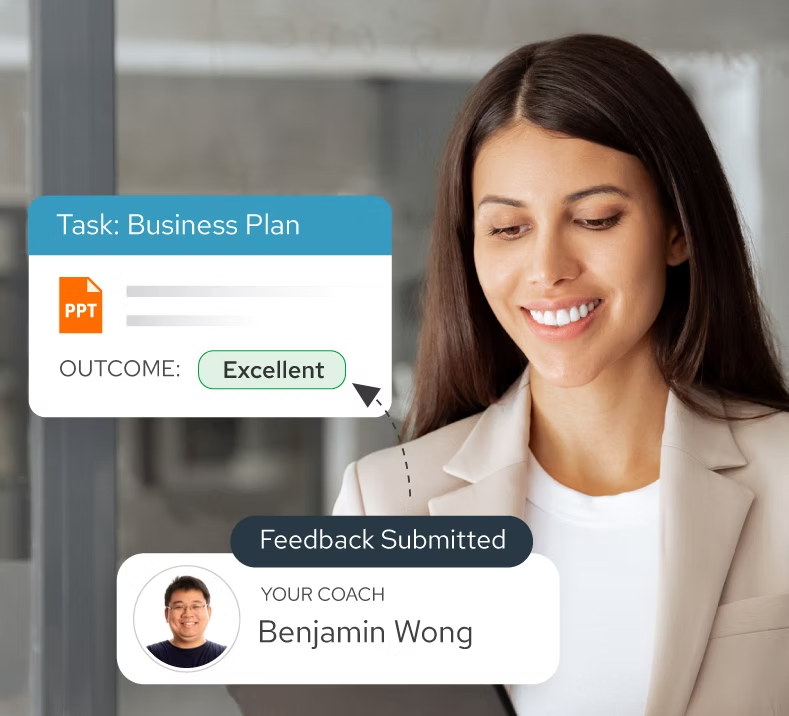
- Review task submissions
- Provide feedback in the platform
- Track coaching touchpoints

Task review and feedback
Ability to review learner assignments and provide contextual feedback within the platform.
Monitor application attempts
- Review workplace projects
- Provide written feedback
- Track feedback history
- Monitor application attempts
Learners nominate their coach during course onboarding or have coaches assigned administratively.
• Nominate manager, mentor, or peer
• Administrative assignment options
• Automated coach notifications
• Clear role expectations
Complete confidence and capability assessments that create structured conversations between learner and coach about development priorities.
• Pre-program capability assessment
• Coach completes separate assessment
• Collaborative final responses
• Identifies development focus areas
Clear visibility into learner progress and completion status.
• View learner progress
• Review task submissions
• Provide feedback in the platform
• Track coaching touchpoints
Ability to review learner assignments and provide contextual feedback within the platform, and monitor application attempts.
• Review workplace projects
• Provide written feedback
• Track feedback history
• Monitor application attempts

Bridge the gap between learning and performance
Your training builds genuine capability. Manager-led coaching ensures that capability makes it to the workplace.
Training providers face a consistent challenge: clients love your programs but struggle to measure their impact. Coaching integration solves this by creating visible, trackable skill application that proves your value and justifies continued investment.
Implementation doesn't require starting from scratch. The right platform lets you layer coaching support onto proven programs, giving facilitators tools to engage managers without adding administrative burden. Your core delivery remains unchanged – coaching amplifies what already works.
BOOK A 30-MINUTE PERSONALISED DEMO
Spend less time juggling tools and more time running your business.
See how Guroo Academy connects your courses, clients, payments and operations in one platform.




References
¹ Weber, E. & Arneill, M. (2019). The Role of Coaching in Learning Transfer. Training Industry.
² Wilson Learning Worldwide (2024). Learning Transfer Model research synthesis.
³ Blume, B.D., Huang, J.L., & Ford, J.K. (2023). Transfer of informal learning: The role of manager support. Business Horizons, 66(6).
⁴ Day, D.V. (2000). Leadership development: A review in context. The Leadership Quarterly, 11(4).
⁵ LinkedIn Learning (2024). Workplace Learning Report.
⁶ LinkedIn Learning (2024). Workplace Learning Report.