Pricing Plans & Purchase Terms
How you price your programs affects everything from cash flow to how buyers perceive your value. This guide walks through seven pricing plans for cohort-based programs, and the purchase terms that should sit behind each one.

This guide covers how to structure pricing plans and purchase terms in Guroo Academy for cohort-based programs with a fixed start date. Start-anytime online courses require a different approach and are covered separately.
The guidance here applies to programs where all participants begin on the same date – including face-to-face leadership programs, blended cohorts, and live online bootcamps. A worked example is used throughout: a New Leader Program, a multi-week cohort designed for people stepping into their first management role.
The guide covers seven pricing plans, recommended price points, and the purchase terms that should sit behind each one.
The four pricing tools, and how they work together
Before we get into the best practice pricing plans, let's make sure we're working from the same definitions. There are four tools in Guroo Academy that work together to manage how customers buy from you, and understanding what each one does (and doesn't do) is the foundation of everything we're about to cover.
Purchase plans
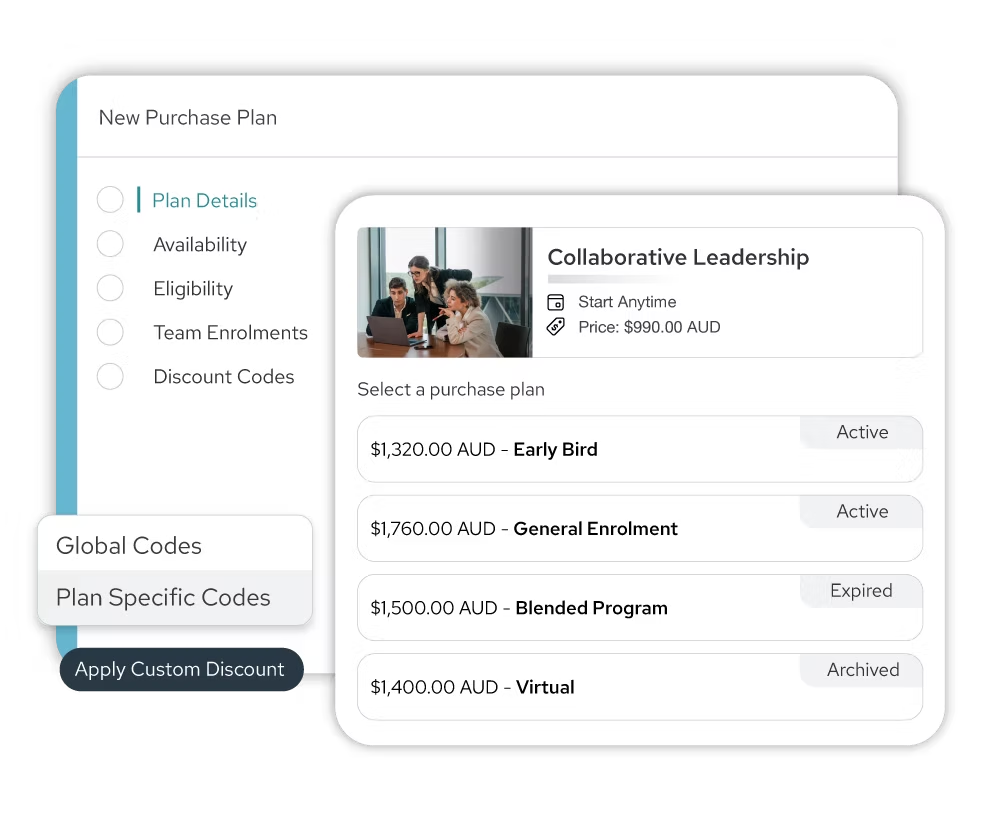
A purchase plan is the core pricing configuration for a program. It defines the price a customer pays, who can see it and when it's available. You can have multiple purchase plans attached to the same program — so the same New Leader Program can simultaneously have an early bird plan, a standard plan, a premium flex plan, and a corporate partner plan, alumni plan and staff plan, all visible to the right buyers at the right time.
To use an airline analogy, think of purchase plans as your seat classes. Just like an airline has economy, premium economy, and business class all on the same flight, your purchase plans let you offer different prices and conditions to different buyers without managing separate programs or running manual processes.
Purchase terms
Purchase terms are the rules that govern what happens after a purchase is made. They define your refund policy, transfer conditions, substitution rules, and any fees that apply when a participant needs to change their enrolment.
In Guroo Academy, purchase terms are attached to the purchase plan, not to the program itself. This distinction is significant.
When terms are applied at the program level, every buyer receives the same policy regardless of what they paid. The participant who paid full price and the participant who received a 20% discount are treated identically when requesting a transfer. That arrangement creates a problem: the discount was given without receiving anything meaningful in return, and full-price flexibility has been extended to someone who did not pay for it.
When terms are applied at the purchase plan level, the conditions reflect the deal that was made. Early bird buyers – who paid less – receive stricter conditions. Premium flex buyers – who paid more – receive the transfer rights they paid a premium for. Price and conditions become a coherent product rather than two elements managed separately.

Multi-seat discounts
A multi-seat discount is a percentage reduction that applies automatically when a single buyer purchases multiple seats in the same program at once for a team. You configure the threshold – for example, 10% off when purchasing three or more seats – and Guroo Academy calculates and applies it at checkout without manual intervention.
Multi-seat discounts are enabled at the purchase plan level, which means they can be applied selectively. A corporate partner plan might include a multi-seat discount to reward bulk bookings. An early bird plan might exclude them, since discounting the price further when it is already reduced is rarely commercially sound.
A multi-seat discount is an exchange: the buyer receives a lower per-seat price, and you receive more participants committed to the same cohort in a single transaction.

Discount codes
A discount code is a promotional tool that applies a percentage reduction to a purchase plan at checkout. Codes can be global (available across all programs) or specific to a particular program.
Discount codes have a notable limitation as a primary pricing strategy: value is given away without receiving anything in return. When you offer an early bird purchase plan with strict terms, you are exchanging a lower price for a real commitment – no future-cohort transfers, a tighter withdrawal window. The buyer receives a discount; you gain certainty. That is a fair exchange.
When you distribute a discount code, you typically receive nothing in return. The buyer pays less, retains full flexibility under standard terms, and you have reduced your revenue per seat without a commercial benefit to offset it.
Purchase plans should be your primary tool for structuring your commercial offer – each plan is a deliberate exchange of price for conditions. Discount codes work best as a secondary layer: a time-limited promotion to generate a burst of demand, a reward for a specific referral, or a targeted offer to a prospect your sales team is working to close. Guroo Academy supports both, and they are not in competition. However, codes should be the exception. Purchase plans should be the rule.

A purchase plan is the core pricing configuration for a program. It defines the price a customer pays, who can see it and when it's available. You can have multiple purchase plans attached to the same program — so the same New Leader Program can simultaneously have an early bird plan, a standard plan, a premium flex plan, and a corporate partner plan, alumni plan and staff plan, all visible to the right buyers at the right time.
To use an airline analogy, think of purchase plans as your seat classes. Just like an airline has economy, premium economy, and business class all on the same flight, your purchase plans let you offer different prices and conditions to different buyers without managing separate programs or running manual processes.
Purchase terms are the rules that govern what happens after a purchase is made. They define your refund policy, transfer conditions, substitution rules, and any fees that apply when a participant needs to change their enrolment. In Guroo Academy, purchase terms are attached to the purchase plan, not to the program itself. This distinction is significant.
When terms are applied at the program level, every buyer receives the same policy regardless of what they paid. That arrangement creates a problem: the discount was given without receiving anything meaningful in return, and full-price flexibility has been extended to someone who did not pay for it.
When terms are applied at the purchase plan level, the conditions reflect the deal that was made. Early bird buyers who paid less receive stricter conditions, and premium flex buyers who paid more receive the transfer rights they paid a premium for. Price and conditions become a coherent product rather than two elements managed separately.
A multi-seat discount is a percentage reduction that applies automatically when a single buyer purchases multiple seats in the same program at once for a team. You configure the threshold, for example 10% off when purchasing three or more seats, and Guroo Academy calculates and applies it at checkout without manual intervention.
Multi-seat discounts are enabled at the purchase plan level, which means they can be applied selectively. A corporate partner plan might include a multi-seat discount to reward bulk bookings, while an early bird plan might exclude them since discounting an already-reduced price is rarely commercially sound.
A multi-seat discount is an exchange: the buyer receives a lower per-seat price, and you receive more participants committed to the same cohort in a single transaction.
A discount code is a promotional tool that applies a percentage reduction to a purchase plan at checkout. Codes can be global (available across all programs) or specific to a particular program.
Discount codes have a notable limitation as a primary pricing strategy: value is given away without receiving anything in return. When you distribute a discount code, the buyer pays less, retains full flexibility under standard terms, and you have reduced your revenue per seat without a commercial benefit to offset it.
Purchase plans should be your primary tool for structuring your commercial offer. Discount codes work best as a secondary layer, such as a time-limited promotion or a targeted offer to a prospect your sales team is working to close. Guroo Academy supports both, but codes should be the exception and purchase plans should be the rule.
Seven pricing plans to consider
For a cohort-based program such as a New Leader Program, seven distinct pricing plans are worth considering. Each serves a different commercial purpose and targets a different type of buyer.
- Early Bird — to generate demand, test the market and get things started
- Standard — your core “advertised” price
- Flexible — for premium customers who want the flexibility to change cohorts
- Package — bundled with online learning and other high margin add ons for higher yield
- Corporate Partner — for organisations making a volume commitment
- Alumni — loyalty pricing for returning participants
- Staff Plans — for large institutions selling seats to other departments or faculties
1. Early bird
The commercial purpose: Create momentum and test demand as you kick off sales.
Early bird pricing isn't just a nice gesture to people who book ahead. Used correctly, it's a demand signal. If you launch and your early bird seats don't fill, you have a problem worth knowing about early — not two weeks before the program starts.
Suggested price point: 20% below your standard price. Enough to create genuine urgency. Not so much that it undermines the perceived value of your program.
If your New Leader Program is priced at $2,500 standard, your early bird rate would sit at around $2,000. When setting up early bird pricing, assign a clear end date — either a fixed calendar date or the 'until X days before enrolment close' option. Either works, but honouring the deadline is important. Extending it undermines the incentive and feels unfair to/disadvantages participants who committed early. It's also worth capping the number of early bird places (typically no more than 25% of cohort capacity) to protect your average yield.
Recommended terms: This is the critical piece most providers get wrong. Early bird pricing should come with the strictest conditions of any plan. You've given them a discount in exchange for an early commitment. That commitment needs to mean something.
- No transfers, withdrawals or refunds or at most a 50% fee and residual stored as credit for a future program.
- No substitutions
- If you do offer transfers make it with at least 60 days notice to give you plenty of time to resell the seat
- No multi-seat discounts
2. Standard pricing
The commercial purpose: Your anchor price. The benchmark everything else is measured against.
Standard pricing is what most of your participants will pay. It needs to reflect the full value of your program without the incentive of too much flexibility or the discount of early commitment.
Suggested price point: Set this based on your market research and delivery costs. For our New Leader Program, let's call it $2,500. This is your default plan for anyone who missed the early bird and isn't buying premium flex or a package - it should always be available until the course is sold out.
Recommended terms:
- Transfers and withdrawals are allowed for a 25% fee + $200 processing fee
- Residual is available as a credit on hold for future programs for 12 months
- Transfers must be 30 days out (or longer if your sales cycle is long for the course)
- Substitutions allowed
- Multiseat discounts enabled
3. Premium flex
The commercial purpose: Capture more revenue from buyers who are willing to pay for flexibility — particularly corporate buyers booking on behalf of executives.
This is one of the most underutilised pricing strategies in the training industry. A buyer whose organisation is paying — especially one booking for a direct report or team member — will often pay a premium to remove the risk of losing money if the participant can't attend. Selling them that flexibility at a higher price is entirely legitimate, and it shortens your sales cycle because they don't need to wait until diaries are confirmed.
Suggested price point: 15-20% above standard. For our New Leader Program example this might be: $3,000
Recommended terms: Here's the key: premium flex buys the customer flexibility to change their mind. It does not have to buy them a cash refund. The chance is they will never use this flexibility and you get the extra revenue for no additional trouble.
- No cash refunds under any circumstances. This is how you get paid regardless. Make this explicit.
- Transfers to same or different program permitted up to 10 days before start — no fee.
- Credit on hold if they withdraw within 10 days of start. Credit valid for 24 months (extended validity is part of the premium).
- Substitutions permitted
- No transfer fee — ever. That's what they paid for.
- Self-service: Both purchaser and learner can initiate changes. Make this fully self-serve — the whole point of premium flex is that customers can manage their own booking without involving your team.
- No multiseat discounts
4. Package pricing
The commercial purpose: Increase revenue per participant without increasing delivery cost.
This is the training provider equivalent of ancillary revenue. Instead of charging more for the same program, you bundle in genuinely useful online content at a price point where the combined value is obvious — and your margin per seat increases significantly.
For our New Leader Program, the natural add-ons are programs that make a new leader more effective in their role. Not more leadership content — they're already buying that — but adjacent skills that complement the core program.
For example, bundle the New Leader Program with access to either a Foundations of Data Analytics online program or a Finance for Non-Financial Managers online self-pacedcourse. Both are skills a new leader needs. Both complement the leadership program without duplicating it. Both are likely assets you already have in your content library — which means your marginal cost of delivery is close to zero.
Suggested price point: Standard price + 30–40% of the online program's standalone value. So if the online programs are each worth $500 standalone, bundle the New Leader Program with both for $3,200 — a clear saving on buying separately, and a $700 increase in your revenue per participant.
Recommended terms: Terms are the same as the standard terms but with the caveat that the online courses can not be withdrawn form after enrolment.
5. Corporate partner pricing
The commercial purpose: Secure forward revenue commitments from organisations that regularly send participants to your programs. This isn't just a discount. It's a partnership. A corporate partner rate is offered in exchange for a commitment — a volume guarantee, a prepaid training budget, or a preferred supplier arrangement. The discount is earned, not given.
Suggested price point: 5-20% below standard depending on the annual spend commitment made. So for our New Leader Program: as low as $2000 per participant.
Recommended terms: Your terms and conditions should be slightly more generous than standard:
- Transfers and withdrawals are allowed for a 20% fee + $100 processing fee
- Residual is available as a credit on hold for future programs for 12 months
- Transfers must be 21 days out (or longer if your sales cycle is long for the course)
- Substitutions allowed
- No multiseat discounts
6. Alumni pricing
The commercial purpose: Retain customers. Create loyalty. Increase lifetime value.
An alum of your New Leader Program who is now leading a larger team is a prime candidate for your Advanced Leadership program, your Strategic Thinking program, or any number of adjacent offerings. Alumni pricing is how you make sure they come back to you rather than your competitor.
Recommended terms: Terms are the same as the standard terms but with the caveat that the online courses can not be withdrawn form after enrolment.
7. Staff pricing
The commercial purpose: Capture internal L&D budget that would otherwise go to external providers.
Big organisations like universities will often go external for training when they could be coming to you. Advertising to staff has a low cost of sales so you can afford to offer a generous discount of about 25%.
Recommended terms: Purchase terms should just be your standard terms for simplicity so they are committed.

Setting up your pricing plans and associated terms is critical to managing your profitability and revenue and Guroo Academy lets you store these in reusable libraries so you only need to do it once. It’s worth taking a little time to plan your pricing strategy and set things up properly.
If you have any questions about how best to apply this to your situation , you can reach out to our team.
BOOK A 30-MINUTE PERSONALISED DEMO
Spend less time juggling tools and more time running your business.
See how Guroo Academy connects your courses, clients, payments and operations in one platform.