The Kirkpatrick Model In Practice

The way people learn at work has changed a lot over the past decade. Professionals now pick up skills through short courses, micro-credentials, CPD programs, and employer-funded training, often several at once. The people paying for that training have changed too. Employers, boards, and funders want to know what they're getting for their investment, and they're asking more often.
For professional education providers, that leaves a familiar problem. You know your programs are good, and your learners tell you so in their end-of-course surveys. But when a sponsor asks whether the program changed anything back in the workplace, a 4.6 out of 5 satisfaction score doesn't really answer the question.
This is where the Kirkpatrick Model comes in. It's been around for decades, most people in learning and development have heard of it, and yet many providers find it hard to put into practice. This guide sets out what each level means and what you can realistically collect at each one, during and after a program.
What is the Kirkpatrick Model?
The Kirkpatrick Model is a framework for evaluating training, built on four levels: Reaction, Learning, Behaviour, and Results. Donald Kirkpatrick first developed it in the 1950s, and it's still the most widely used approach to training evaluation today.
The idea behind it is simple. Each level builds on the one before it. Learners need to respond well to a program before they'll learn from it, they need to learn before they can change how they work, and their work needs to change before the organisation sees results.
It's important to note that the model isn't a checklist you must complete in full for every program. It's a way of thinking about what evidence you have, what you're missing, and what your sponsors care about most.
What are the four levels of the Kirkpatrick Model?
Here's a quick summary of what each level tells you:
- Reaction: how learners felt about the program, including whether it was relevant, engaging, and well delivered.
- Learning: what knowledge, skills, or confidence learners gained by the end of the program.
- Behaviour: whether learners are applying what they learned once they're back at work.
- Results: the outcomes the program contributes to, such as better performance, fewer errors, or higher retention.
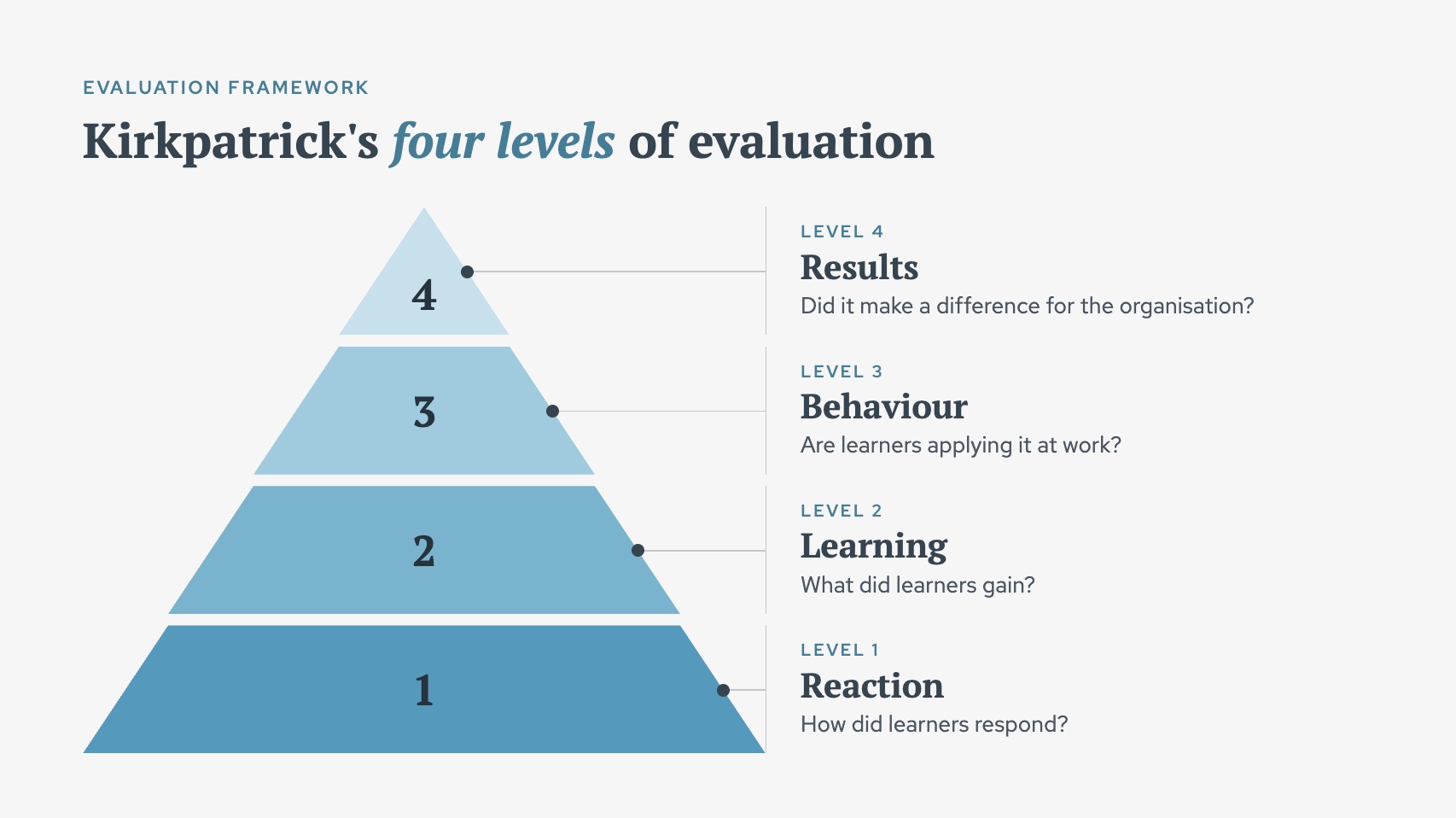
Most providers collect plenty of Level 1 data, some Level 2 data, and very little at Levels 3 and 4. That's understandable, because the higher levels happen after the program ends, when learners have moved on and you've lost contact with them. The good news is that you don't need a research team to close the gap. You mainly need to plan what to ask, and when.
Level 1: Reaction
Level 1 measures how learners responded to the program. Did they find it useful? Was the facilitator effective? Would they recommend it to a colleague?
This is the level most providers already measure well, usually through an end-of-course survey. The data is useful, but its value depends a lot on how you ask. A satisfaction rating on its own tells you very little, while a rating followed by a short "why did you give this score?" question gives you something you can act on.
Say you run a six-week leadership program for members of a professional association. If session three gets noticeably lower ratings than the rest, the follow-up comments might tell you the case study felt out of date, or that the session ran over time. That's a fix you can make before the next intake, which a single score wouldn't show you.
What to collect: satisfaction and relevance ratings, facilitator and session feedback, Net Promoter Score, and open comments.
When to collect it: at the end of each session or module, at the end of the program, and through an always-open feedback option so learners can raise issues while there's still time to fix them.
Level 2: Learning
Level 2 measures what learners gained by the end of the program. For many professional education providers, this is partly covered by assessments, but there's a simpler layer that's often overlooked: how confident learners feel applying what they've learned.
A useful approach is to ask learners to rate their confidence in the program's key skills at the start and again at the end. For example, a university short course in project management might ask learners to rate their confidence in building a project schedule, managing stakeholders, and reporting on risk. Comparing the two sets of answers shows where the program made a difference and where it didn't.
Self-rated confidence isn't the same as proven competence, so it works best alongside assessment results rather than in place of them. Even so, it's quick to collect and easy for sponsors to understand.
What to collect: assessment results, before-and-after confidence ratings, and learner reflections on what they'll take away.
When to collect it: at enrolment or the first session, and again at the end of the program.
Level 3: Behaviour
Level 3 is where many evaluation efforts stop, and it's also where sponsors start paying close attention. The question here is whether learners are doing anything differently at work.
You can't observe every learner in their workplace, but you can ask them, and you can help them commit to specific changes before the program ends. Two approaches work well together.
The first is a workplace action plan. Towards the end of the program, each learner sets out two or three specific actions they'll take back at work, such as running a fortnightly one-on-one with each team member or applying a new risk framework to their next project. Later, they review their progress against those actions, and if they're working with a coach or manager, they can share the plan with them for support.
The second is a follow-up survey, sent 30, 60, or 90 days after the program. At 30 days, you might ask what learners have tried so far. At 90 days, you can ask what's stuck, what hasn't, and what got in the way. That last question is often the most useful, because the barriers learners report (lack of time, no manager support, systems that don't allow the change) are things a sponsor can often fix.
What to collect: action plan progress, self-reported changes in practice, barriers to applying the learning, and, where possible, manager or coach observations.
When to collect it: action plans at the end of the program, then follow-up surveys at 30, 60, and 90 days after each learner finishes.
Level 4: Results
Level 4 looks at the outcomes the program contributes to. For a corporate client, that might be fewer safety incidents, faster onboarding, or improved customer satisfaction. For a professional association, it might be stronger member retention or better practice standards across the profession.
This is the hardest level to measure, and it's worth being honest about why. Business results are affected by many things besides training, and the data usually sits with the sponsor, not with you. A training business delivering compliance training for an employer client won't have access to that client's incident reports unless they agree to share them.
That doesn't mean you should skip Level 4. It means the conversation starts before the program does. Ask your sponsor what outcomes they're hoping for and how they currently measure them. Then build your Level 3 questions around those outcomes, so your behaviour data connects clearly to the results they care about. When you report back, you can show the chain of evidence: learners valued the program, gained confidence in these skills, applied them in these ways, and here's the outcome data the sponsor has shared alongside it.
What to collect: the sponsor's agreed success measures, their outcome data where they can share it, and learner and manager reports that link changes in practice to those outcomes.
When to collect it: agree on measures before the program starts, then review at an agreed point afterwards, often three to six months later.
How to use the Kirkpatrick Model as a professional education provider
If you're starting from mostly end-of-course surveys, don't try to build all four levels at once. A practical order is:
- Improve your Level 1 questions by adding a "why?" follow-up to key ratings, and use the same questions across programs so you can compare results over time.
- Add before-and-after confidence ratings for Level 2.
- Introduce workplace action plans and a single follow-up survey at around 60 or 90 days for Level 3.
- For your largest or most strategic programs, agree on Level 4 measures with the sponsor upfront.
Each step gives you better evidence than the last, and by the time you reach step three you'll have a much stronger story to tell sponsors than satisfaction scores alone.
Putting it into practice with Guroo Academy
We built Evaluations in Guroo Academy to make this kind of evaluation practical for professional education providers. You can create reusable question libraries, collect session and facilitator feedback, keep an always-open feedback channel for learners, schedule follow-up surveys from each learner's finish date, and support workplace action plans that learners can share with a coach. When it's time to report, you can share results with sponsors and export them as a PDF.
We'll be walking through all of this in our webinar on 23 October. [Register here – link to add]
Frequently asked questions
What are the four levels of the Kirkpatrick Model?
The four levels are Reaction, Learning, Behaviour, and Results. They measure how learners responded to a program, what they learned, whether they applied it at work, and what outcomes followed.
Is the Kirkpatrick Model still relevant?
Yes. It's still the most widely used training evaluation framework because it's simple to explain and maps well to what sponsors want to know. Most providers use it as a guide, not a rigid process.
How long after training should you evaluate behaviour change?
Most providers send follow-up surveys between 30 and 90 days after a program ends. Thirty days shows early application, while 90 days shows whether the change has stuck.
What is the difference between Level 3 and Level 4 in the Kirkpatrick Model?
Level 3 measures whether individual learners are changing how they work. Level 4 measures the wider outcomes for the organisation, such as performance, safety, or retention, that those changes contribute to.
Do you need to measure all four levels for every program?
No. Match the depth of evaluation to the program's size and importance. A short webinar might only need Level 1, while a funded leadership program is worth evaluating at all four levels.
BOOK A 30-MINUTE PERSONALISED DEMO
Spend less time juggling tools and more time running your business.
See how Guroo Academy connects your courses, clients, payments and operations in one platform.