Enhancing your in-person courses
Face-to-face training is powerful, but without structured support before and after the classroom, much of what participants learn doesn't make it back to the workplace.
This guide walks you through creating a complete learning journey that extends your in-person programs beyond the room.

The renewed value of in-person learning
The COVID-19 pandemic led to a significant shift to online delivery. While many organisations discovered the convenience and reach of digital learning, they also rediscovered what makes face-to-face training irreplaceable.
In-person courses create the human connection, spontaneous collaboration, and immersive focus that virtual sessions struggle to replicate. Participants consistently report higher engagement, stronger peer relationships, and deeper skill development from face-to-face experiences.
By thoughtfully integrating digital elements before and after your classroom sessions, you preserve the irreplaceable value of face-to-face interaction while addressing its historical weakness: the lack of structured support for workplace application. This blended approach delivers the engagement and connection of in-person training with the support that drives genuine behaviour change.
The complete learning journey
Maximise the impact of your face-to-face training programs by creating a complete learning experience that spans before, during, and after the classroom.
Face-to-face training provides opportunities for connection, collaboration, and skill development. However, without structured pre-work and follow-up, much of what participants learn never makes it to the workplace.
Without ongoing support, learners experience significant knowledge loss in the hours and days following training. This isn't a failure of your facilitation or content. It's a limitation of the format itself. When learning begins and ends in the classroom, participants often lack the preparation, context, and ongoing support necessary to integrate new skills into their daily work.
Enhanced in-person courses solve this by creating a complete learning journey that strengthens every phase of skill development.

Before the classroom: building foundation and context

Pre-work that prepares
Effective pre-course activities transform how participants engage with your face-to-face sessions. Rather than using in-person time for foundational knowledge, participants arrive ready for deeper application and discussion, with shared vocabulary and a clearer sense of their own development needs.

Diagnostic assessments
Pre-course diagnostics go beyond measuring starting capability. They help learners identify development priorities, give facilitators insight to adapt their delivery, and create a baseline for measuring progress. The most effective diagnostics involve both the learner and their manager, creating alignment before training begins.

Setting clear expectations
Pre-course communications should clarify what participants will learn, how it connects to their role, what preparation is required, and what support follows the course. This context-setting helps participants approach training as part of their ongoing development, rather than a standalone event.
During the classroom: maximising face to face value

Focus on application
With foundational knowledge covered in pre-work, classroom time becomes far more valuable. Use it for activities that require human interaction — complex problem-solving, skill practice with feedback, case study analysis, and peer discussion. These are the experiences that digital delivery struggles to replicate.

Workplace connection
The most effective in-person training connects directly to participants' real work contexts. This might mean bringing actual workplace challenges into the classroom, creating action plans for immediate application, or working on projects that continue after the course. When participants see clear links between classroom activities and their daily work, engagement and skill transfer both increase.

Building peer networks
Face-to-face sessions create opportunities for participants to build professional relationships that extend well beyond the course itself. These peer networks become valuable resources for ongoing learning and problem-solving. Deliberately structure sessions to facilitate these connections through collaborative activities, peer coaching, and shared reflection.
After the classroom: supporting application and embedding

Structured follow up
Post-course activities maintain momentum and support skill application back in the workplace. These can include workplace projects, reflection exercises, micro-learning modules, or practice opportunities with feedback. The goal is to create regular touchpoints that keep learning active as participants navigate the challenges of applying new skills in a real work environment.

Manager support
When managers actively support skill application through coaching conversations, participants are far more likely to embed new capabilities. Effective involvement includes pre-course conversations, check-ins during the training period, and structured coaching on workplace application. This is enabled by Guroo Academy's integrated coaching features, including coach dashboards, task review, and progress tracking.
.avif)
Measuring impact
Enhanced courses create opportunities to measure real skill development, going beyond course satisfaction scores to demonstrate genuine capability change. Post-course assessments compared to pre-course diagnostics show growth, workplace projects provide evidence of application, and manager observations confirm behavioural change. Together, this evidence builds a compelling case for continued investment in your programs.
Step-by-step implementation guide
Here are some steps we recommend for building your enhanced learning experience.
Audit your current experience
Map what currently happens before, during, and after your face-to-face sessions to identify where structured support is missing.
Prepare coaches
Equip coaches with guides, conversation starters, and coaching frameworks, and set clear expectations around time commitment and value.
Set up your technology
Choose a platform with nomination workflows, coach dashboards, diagnostics, and feedback tools to make implementation seamless.
Create engagement strategies
Keep coaches and learners engaged throughout the journey with automated reminders, recognition, and on-demand resource libraries.
Pilot, monitor and optimise
Start with your strongest programs to build proof points, then track engagement and workplace application to measure impact and scale what works.
How Guroo Academy powers enhanced in-person learning
Without the right platform, coaching becomes an administrative burden. Guroo Academy makes it operationally simple.
Pre-course management
Guroo Academy handles the complexity of pre-course preparation through automated enrolment and onboarding, integrated diagnostic assessments, coach nomination workflows, and scheduled pre-work delivery. Participants receive clear instructions on what to complete before their face-to-face session, while facilitators gain visibility into preparation status and diagnostic results that inform classroom delivery.

Face-to-face integration
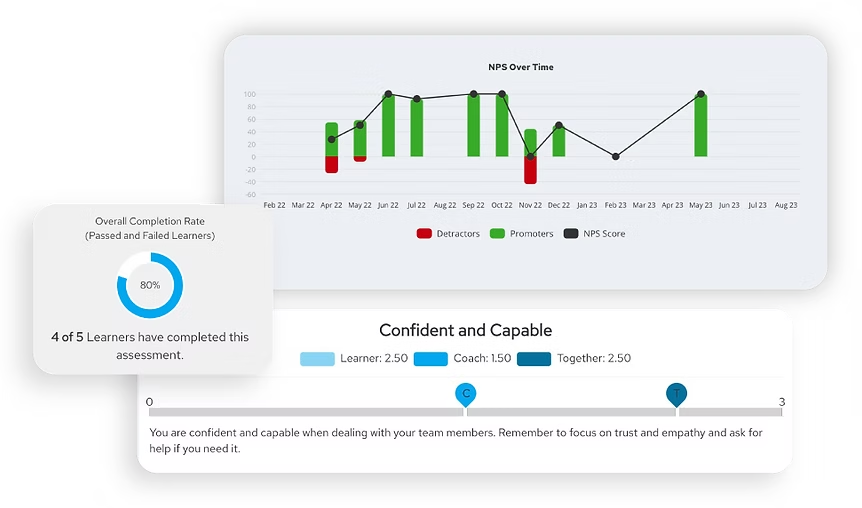
Your in-person sessions remain at the centre of the learning experience, with digital elements enhancing rather than replacing them. The platform provides access to course materials during sessions, facilitates easy sharing of resources and activities, and tracks real-time learner progress to inform facilitation. Complete confidence and capability assessments that create structured conversations between learner and coach about development priorities.

Follow-up support
Post-course activities maintain engagement and support workplace application through scheduled task release and reminders, workplace project submission and review, manager coaching touchpoints, and progress tracking and reporting.
Dedicated coach dashboards show learner progress and completion status. Coaches can review submitted work, provide feedback within the platform, and track coaching touchpoints.

Measurement and Reporting
Demonstrate the impact of your enhanced courses through pre- and post-course diagnostic comparison, workplace application evidence, completion and engagement metrics, and custom reporting for stakeholders.This data proves the value of enhancement and builds the case for continued investment in your programs.
Guroo Academy handles the complexity of pre-course preparation through automated enrolment and onboarding, integrated diagnostic assessments, coach nomination workflows, and scheduled pre-work delivery. Participants receive clear instructions on what to complete before their face-to-face session, while facilitators gain visibility into preparation status and diagnostic results that inform classroom delivery.
Your in-person sessions remain at the centre of the learning experience, with digital elements enhancing rather than replacing them. The platform provides access to course materials during sessions, facilitates easy sharing of resources and activities, and tracks real-time learner progress to inform facilitation. Complete confidence and capability assessments that create structured conversations between learner and coach about development priorities.
Post-course activities maintain engagement and support workplace application through scheduled task release and reminders, workplace project submission and review, manager coaching touchpoints, and progress tracking and reporting. Dedicated coach dashboards show learner progress and completion status. Coaches can review submitted work, provide feedback within the platform, and track coaching touchpoints.
Demonstrate the impact of your enhanced courses through pre- and post-course diagnostic comparison, workplace application evidence, completion and engagement metrics, and custom reporting for stakeholders. This data proves the value of enhancement and builds the case for continued investment in your programs.

Transform your training impact
Your face-to-face courses already deliver value. Enhancement multiplies that value by ensuring learning extends beyond the classroom into genuine workplace capability.
Training providers who successfully enhance their courses report higher client satisfaction, stronger evidence of impact, easier renewals and expansion, and differentiation from competitors.
The investment in enhancement pays dividends through programs that demonstrably change workplace performance – the outcome every training client truly wants.
BOOK A 30-MINUTE PERSONALISED DEMO
Spend less time juggling tools and more time running your business.
See how Guroo Academy connects your courses, clients, payments and operations in one platform.