The Three Stages of Training Business Growth
Updated April 2026.
Most training businesses don't fail because of poor programs or a lack of demand. They plateau because their operational infrastructure can't support the next stage of growth. Understanding which stage you're currently in – and what it takes to move to the next – is one of the most useful frameworks for making smart investment decisions.
This guide outlines the three stages most training businesses progress through, what works at each stage, what creates the growth ceiling, and what's required to move forward.
Why Growth Follows Stages
Training businesses at different revenue levels face fundamentally different operational challenges. The manual processes that work efficiently at 20 programs per year create chaos at 100. The disconnected tools that serve a small team become a significant drag as the team grows.
Growing small businesses are twice as likely to have an integrated tech stack (66% vs. 32% for declining businesses), meaning their various software tools communicate with each other and provide a unified view of the business (Chalifour Consulting, 2026). The businesses that scale most successfully are those that proactively build the foundations for their next stage before hitting the growth ceiling of their current one – investing in operational infrastructure while revenue still seems manageable with existing approaches.
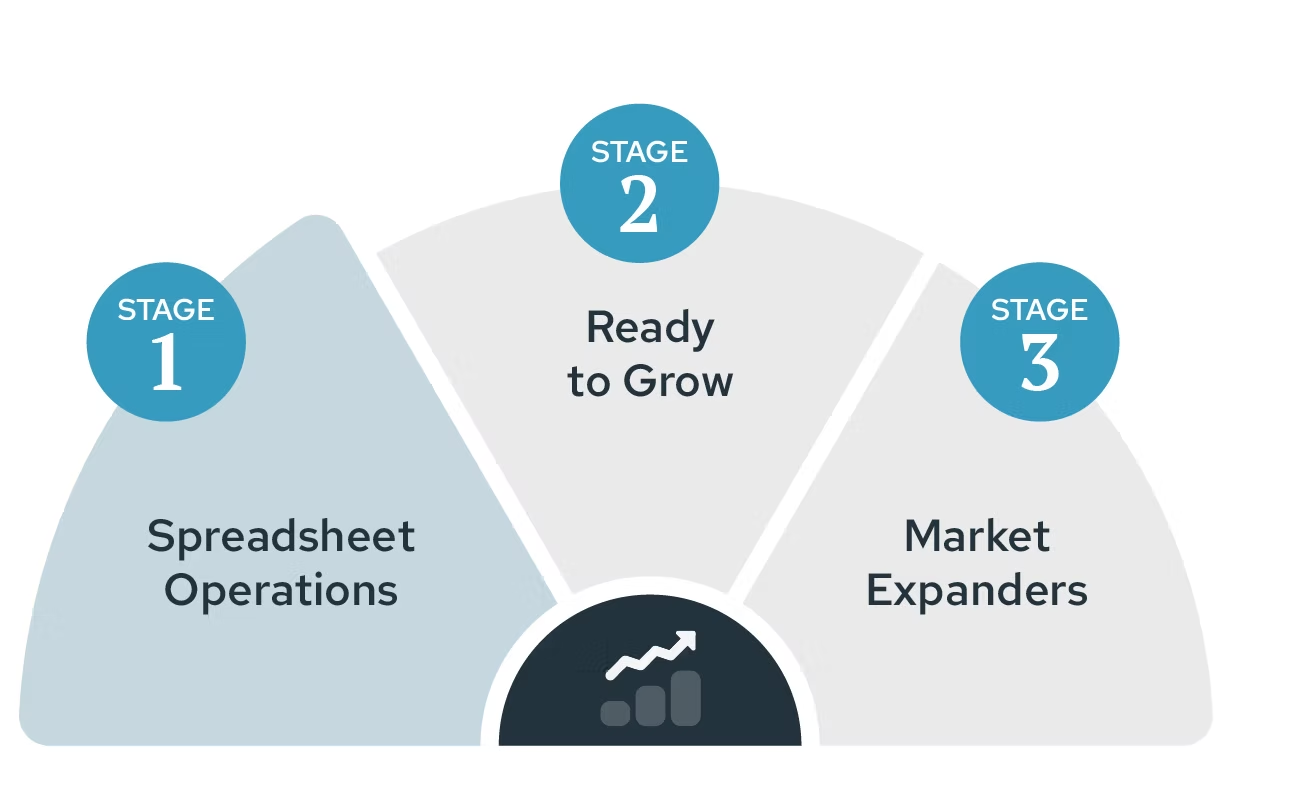
Stage Overview
Stage 1: Spreadsheet Operations
Typically under $500k revenue
At this stage, the business runs primarily through spreadsheets, email, and disconnected tools. The owner is heavily involved in program delivery, client relationships, and most decisions. Team members spend 80% or more of their time on administrative tasks with minimal capacity for business development.
What works here
Direct owner involvement creates deep client relationships and ensures quality control. Clients appreciate access to the business owner rather than being passed to junior team members. Manual processes provide flexibility to customise each program without being constrained by systematic workflows. Low technology overhead keeps costs manageable while you establish your market position and test what works.
The growth ceiling
Capacity is limited by the owner's availability. Revenue growth comes from working harder rather than working smarter. When an enterprise client asks for regular reporting, multiple delivery locations, and a professional learner platform, you lack the operational capability to meet those expectations.
What's required to progress
- Automate core administrative processes – scheduling, invoicing, routine client communication
- Create standard materials and processes that allow other facilitators to deliver consistently without close supervision
- Build capacity for business development rather than purely reactive operations
Stage 2: Ready to Grow
Typically $500k – $2m revenue
Ready to Grow businesses have multiple tools in place, but they don't integrate well, still requiring manual data transfer between systems. The owner can focus more on business development but is frequently pulled back into operational problem-solving. Some automation exists, but significant manual intervention is still required for most processes.
What works here
You've established market credibility and have repeatable programs that clients value. Revenue is more predictable. Team members can deliver some programs independently. You understand your operational weaknesses and have started addressing them through technology.
The growth ceiling
Multiple disconnected systems create administrative overhead that limits efficiency gains. You can't deliver enterprise-grade client experiences that larger organisations expect – self-service portals, real-time reporting, and integrated communication systems still require manual workarounds. Expanding into new geographies or service offerings requires significant operational adaptation each time.
What's required to progress
- Consolidate tools into integrated platforms that eliminate manual data transfer
- Build enterprise-grade client and learner experiences that match the expectations of larger accounts
- Create post-program engagement and pathway programs that extend customer relationships beyond single transactions
- Develop scalable onboarding processes for new team members and facilitators
- Establish operations that run independently with minimal leadership involvement in day-to-day delivery
Stage 3: Market Expanders
Typically $2m+ revenue
Market Expanders have integrated systems – typically one or two comprehensive platforms covering most business functions. Operations run independently with minimal leadership involvement in day-to-day delivery. Client and learner experiences are professional, consistent, and largely automated. The business can scale program capacity quickly without major operational disruption.
What works here
Your infrastructure supports rapid scaling without compromising quality. Enterprise clients view you as a strategic partner rather than just a program vendor. Team members have protected time for business development rather than being consumed by operational coordination. Technology enables rather than constrains your growth ambitions. The business generates profit efficiently because operational excellence creates margin.
The growth opportunities
- Geographic expansion into new markets becomes operationally feasible
- Multi-year enterprise partnerships and complex engagements are within delivery capacity
- White-label or licensing opportunities that leverage your intellectual property and infrastructure
- Strategic acquisitions of smaller training businesses, integrated onto your platform and systems
What's required to progress further
- Enhanced learning experiences – AI-powered personalisation, integrated coaching, or adaptive learning pathways
- Custom enterprise solutions and co-branding capabilities for strategic accounts
- eCommerce functionality for self-service purchasing of standard programs
- Partner programs that extend reach through other organisations
Identifying Which Stage You're In
You're likely a Spreadsheet Operator if:
- The business owner is heavily involved in most program delivery and client relationships
- Client information, scheduling, and financials are tracked primarily through spreadsheets and disconnected tools
- Your team would struggle to deliver a program professionally if the business owner was unavailable
- Team members spend most of their time on administrative coordination rather than business development
You're likely Ready to Grow if:
- You have multiple tools that don't communicate well, requiring manual data transfer between systems
- You can deliver quality programs but worry about handling enterprise-scale opportunities confidently
- The owner is frequently pulled back into operational issues despite wanting to focus on strategy
- You have some automation but still significant manual intervention for most processes
You're likely a Market Expander if:
- Operations run systematically with minimal owner involvement in day-to-day delivery
- You can confidently say yes to complex enterprise opportunities and deliver professionally
- Team members have clear capacity and protected time for business development
- You can scale program delivery quickly in response to market demand
A Note on Progression
Most training businesses progress through these stages, though not always at the same pace or in a perfectly linear way. Some businesses plateau at a particular stage because it serves their goals adequately – and that's a legitimate choice. Others progress rapidly when they invest proactively in next-stage infrastructure.
Your stage isn't a judgment of your business quality. It's a description of your operational maturity. The question is whether your current stage supports where you want to take your business, or whether you've outgrown your operational foundation.
The businesses that scale most successfully invest in the next stage before they urgently need it – accepting the temporary discomfort of transition rather than waiting until the growth ceiling becomes a crisis.
Frequently Asked Questions
Can I skip a stage?
In theory, yes – but it's rare in practice. The operational maturity that Stage 2 and Stage 3 require is usually built through the experience of hitting and resolving Stage 1 and Stage 2 constraints. Businesses that try to build Stage 3 infrastructure from a Stage 1 base often find themselves with expensive systems they don't have the team capability or processes to use effectively.
How long does each stage typically last?
It varies significantly based on market conditions, investment decisions, and growth ambition. Some businesses spend years at Stage 1 by choice; others move through it quickly. The key variable is usually when the owner decides the manual approach is no longer sustainable and invests in the infrastructure for the next stage.
What's the most common mistake at each stage?
At Stage 1: staying too long and missing growth opportunities because the owner is reluctant to invest in infrastructure before revenue clearly justifies it. At Stage 2: adding more disconnected tools to solve individual problems rather than consolidating to an integrated platform. At Stage 3: underinvesting in business development capacity because operations feel smooth and revenue is growing without it.
Does Guroo Academy support training businesses at all three stages?
Yes – Guroo Academy is designed to grow with your training business, from core program delivery and client management at Stage 1, through integrated operations and enterprise-grade client experience at Stage 2, to advanced analytics, partner programs, and eCommerce capability at Stage 3. Book a demo below to see how it works in practice.
BOOK A 30-MINUTE PERSONALISED DEMO
Spend less time juggling tools and more time running your business.
See how Guroo Academy connects your courses, clients, payments and operations in one platform.